
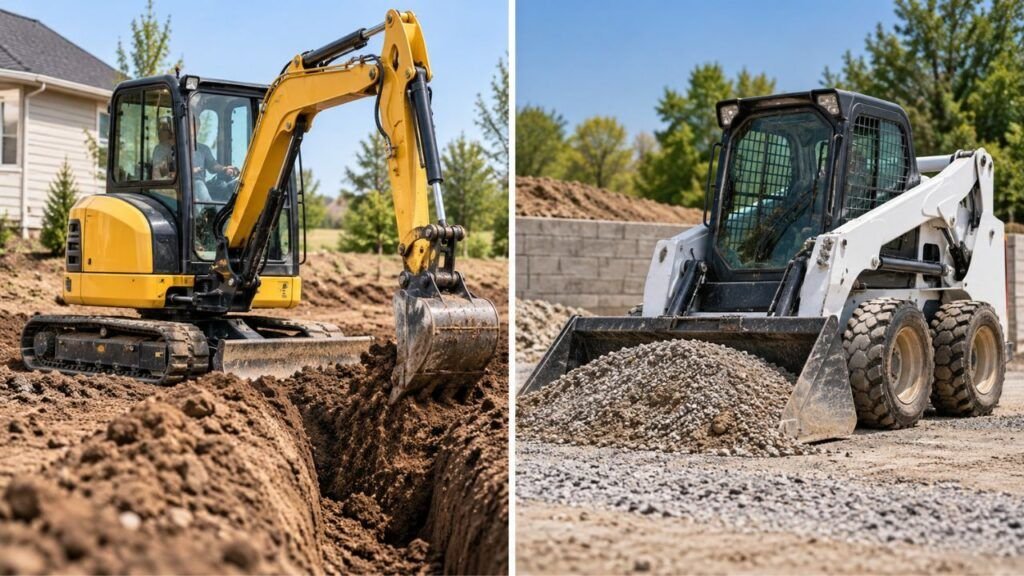
A skid steer generally does more different jobs because it moves materials quickly, grades surfaces, and works with many attachments. However, a mini excavator does much more when your project involves deep digging, trenching, reaching, or precise excavation.
The better machine depends on what your project actually requires. Below, I’ll compare digging, grading, landscaping, attachments, speed, access, transportation, costs, and common jobsite tasks.
Key Takeaways
- Choose a mini excavator for deep digging, trenching, and precision work.
- Choose a skid steer for grading, loading, carrying, and material handling.
- Skid steers generally support a wider variety of attachments.
- Mini excavators can work without constantly repositioning their tracks.
- Compact track loaders behave differently from wheeled skid steers.
- Ground conditions and site access can quickly change your decision.
- Large projects often move faster when both machines work together.
Mini Excavator vs Skid Steer at a Glance
Both machines are compact and extremely useful on smaller jobsites. However, their designs make them much better at completely different tasks.
| Comparison | Mini Excavator | Skid Steer | Better Choice |
| Deep digging | Excellent | Limited | Mini excavator |
| Trenching | Excellent | Attachment dependent | Mini excavator |
| Digging precision | Excellent | Moderate | Mini excavator |
| Reach | Excellent | Limited | Mini excavator |
| Material moving | Limited | Excellent | Skid steer |
| Loading trucks | Good | Excellent | Skid steer |
| Rough grading | Good | Excellent | Skid steer |
| Attachment variety | Good | Excellent | Skid steer |
| Travel speed | Slow | Fast | Skid steer |
| Tight excavation work | Excellent | Good | Mini excavator |
| Finished lawn work | Usually better | Can damage turf | Mini excavator |
| Snow removal | Limited | Excellent | Skid steer |
| Below-grade work | Excellent | Limited | Mini excavator |
| General property maintenance | Good | Excellent | Skid steer |
If you mainly need to dig, the mini excavator usually wins. If you need to move material repeatedly, the skid steer usually wins.
Skid Steer vs Compact Track Loader: Know the Difference
You may hear people use “skid steer” for several loader types. However, a traditional skid steer and compact track loader are different.
A skid steer normally runs on four wheels. It turns by varying wheel speed between the machine’s sides.
A compact track loader, commonly called a CTL, uses rubber tracks. It still performs many of the same loader-style jobs.
That undercarriage difference changes how each machine works on the ground.
A wheeled skid steer usually moves faster on hard surfaces. Tires also tend to cost less than maintaining tracked undercarriages.
A compact track loader usually performs better in mud and soft soil. Its tracks spread machine weight across a larger surface area.
For this article, “skid steer” refers mainly to wheeled machines. However, I’ll mention CTLs whenever their performance changes the comparison.
What Are Mini Excavators and Skid Steers Built to Do?
The easiest way to compare these machines is by design. Each machine was developed around a different type of work.
What a Mini Excavator Is Built For
A mini excavator uses a boom, stick, bucket, and rotating upper structure. Most compact models ride on rubber tracks.
The machine can stay mostly stationary while its upper body rotates. That ability makes excavation much more controlled around tight areas.
Mini excavators are commonly used for:
- Utility trenching
- Foundation excavation
- Drainage work
- Stump removal
- Digging around structures
- Small demolition projects
- Retaining wall trenches
- Pool and pond excavation
- Rock and root removal
Many mini excavators also have a small front blade. That blade helps with backfilling and light grading.
What a Skid Steer Is Built For
A skid steer is primarily a compact loader. Its lifting arms move a bucket or attachment at the front.
The machine is designed to push, scoop, carry, and dump material. That makes it extremely productive across open jobsites.
Skid steers are commonly used for:
- Moving dirt
- Moving gravel
- Loading trailers
- Rough grading
- Spreading topsoil
- Snow removal
- Pallet handling
- Brush clearing
- Sweeping
- Demolition cleanup
- Attachment-powered jobs
This design makes the skid steer one of the most versatile machines available.
Mini Excavator vs Skid Steer for Digging
Digging is where these machines separate very quickly. The mini excavator is purpose-built for working below ground level.
Digging Depth
A mini excavator can reach several feet below its tracks. The exact depth depends on machine size and boom configuration.
Many common residential machines can dig roughly 8 to 12 feet. Larger compact excavators may reach considerably deeper.
A standard skid steer bucket cannot match that working geometry. It mainly pushes forward instead of reaching downward.
Winner: Mini excavator.
Digging Precision
The mini excavator also gives you far more bucket control.
You can independently move the boom, stick, bucket, and upper structure. That helps when working near pipes, walls, roots, and foundations.
A skid steer usually approaches material from the front. That makes delicate below-grade excavation much harder.
Winner: Mini excavator.
Hard Soil and Buried Objects
A mini excavator can curl its bucket through compacted soil. It can also work around large rocks and buried roots.
Hydraulic thumbs further improve control over rocks, logs, and demolition debris.
A skid steer can push aggressively into material. However, its bucket geometry remains better suited to loading than excavation.
Winner: Mini excavator.
Mini Excavator vs Skid Steer for Trenching
A mini excavator is generally the better trenching machine. Its boom and bucket provide excellent control over trench depth and width.
You can dig utility trenches, drainage trenches, footings, and retaining wall trenches. The machine can also reposition material along either side.
A skid steer can still trench with a dedicated trencher attachment. These attachments work particularly well for narrow, consistent trenches.
For example, they may work well for certain irrigation lines. They can also work for some cable installations.
However, a trencher attachment is less flexible around obstacles. It also cannot replace an excavator for larger excavation work.
If you need varying depths or wider trenches, choose the excavator.
Winner: Mini excavator.
Mini Excavator vs Skid Steer for Moving Material
This is where the skid steer becomes the stronger machine. Moving material is what a loader is designed to do.
A skid steer can scoop material, drive across the property, and dump it. It can repeat this cycle much faster than most excavators.
Common materials include:
- Gravel
- Soil
- Mulch
- Sand
- Base rock
- Demolition debris
- Topsoil
- Snow
A mini excavator can move material around its working area. However, carrying material across a property becomes slow.
Excavators also travel much slower than skid steers.
If you need twenty bucket loads moved across a yard, speed matters. The skid steer can save a considerable amount of time.
Winner: Skid steer.
Mini Excavator vs Skid Steer for Grading
Both machines can perform basic grading work. However, a skid steer usually handles larger areas more efficiently.
A skid steer can spread gravel, soil, and base material quickly. Operators can also use grading buckets and specialized grading attachments.
This makes the machine useful for driveway preparation and building pads.
A mini excavator can perform grading with its front blade. The bucket can also shape slopes and backfill trenches.
However, grading large open areas becomes slower with an excavator.
For driveway grading, pad preparation, and soil spreading, choose the skid steer.
Winner: Skid steer.
Mini Excavator vs Skid Steer for Lifting and Loading
Lifting capability depends heavily on machine size and configuration. However, each machine handles different lifting tasks better.
A skid steer is excellent for loading loose material. It can quickly fill trailers, trucks, and dumpsters.
Add pallet forks, and it becomes useful for moving building materials.
A mini excavator handles awkward buried objects differently. It can lift rocks, logs, pipes, or stumps using its boom.
A hydraulic thumb improves this capability considerably.
However, excavator lifting capacity changes with boom position and working radius. Always follow the manufacturer’s lifting chart.
For routine loading and pallet handling, the skid steer wins.
For reaching and handling awkward objects, the excavator can be better.
Overall winner: Skid steer for general material handling.
Which Machine Has More Attachments?
Attachments greatly expand what both machines can accomplish. However, skid steers generally offer the broader attachment ecosystem.
Common Mini Excavator Attachments
Popular mini excavator attachments include:
- Digging buckets
- Grading buckets
- Hydraulic thumbs
- Grapples
- Augers
- Hydraulic breakers
- Rippers
- Compactors
- Brush cutters
These attachments mainly improve excavation, demolition, and land-clearing work.
Common Skid Steer Attachments
Skid steers can use a very wide attachment selection, including:
- General-purpose buckets
- Grapple buckets
- Pallet forks
- Augers
- Trenchers
- Brush cutters
- Land planes
- Snow blowers
- Snow blades
- Sweepers
- Stump grinders
- Tree pullers
- Hydraulic breakers
That attachment variety makes the skid steer exceptionally flexible.
However, attachments have limits.
Adding a trencher does not transform a skid steer into an excavator. Likewise, adding a blade does not turn an excavator into a loader.
Winner for attachment variety: Skid steer.
Which Machine Is Faster?
A skid steer normally travels much faster than a mini excavator. That difference becomes important when material travels across larger sites.
Mini excavators are intentionally slow-moving machines. Their tracks prioritize stability and controlled positioning.
Skid steers are designed for repeated travel between loading and dumping areas.
However, travel speed does not tell the entire story.
An excavator can stay parked while rotating its upper structure. It can dig on one side and dump on another.
That reduces repositioning during excavation.
So the answer depends on the work.
For hauling and repeated travel, the skid steer is faster.
For dig-swing-dump cycles, the excavator can be extremely efficient.
Mini Excavator vs Skid Steer by Project
Different projects favor different machines. This table provides a practical starting point before you rent anything.
| Project | Better Machine | Main Reason |
| Utility trench | Mini excavator | Depth and control |
| French drain | Mini excavator | Precise trenching |
| Foundation digging | Mini excavator | Below-grade reach |
| Pool excavation | Mini excavator | Deep excavation |
| Stump removal | Mini excavator | Root access |
| Boulder removal | Mini excavator | Digging and controlled handling |
| Retaining wall footing | Mini excavator | Controlled trench depth |
| Loading dirt | Skid steer | Faster cycles |
| Moving gravel | Skid steer | Carrying speed |
| Driveway grading | Skid steer | Fast spreading |
| Spreading topsoil | Skid steer | Efficient material distribution |
| Pallet handling | Skid steer | Fork attachments |
| Snow removal | Skid steer | Speed and attachments |
| Site cleanup | Skid steer | Fast debris movement |
| Brush clearing | Skid steer | Powerful attachments |
| Fence post holes | Either | Depends on access |
| Light demolition | Either | Depends on structure |
| Backyard excavation | Mini excavator | Access and digging control |
| Large landscaping job | Often both | Digging plus material handling |
The table also shows why no machine wins every category.
Mini Excavator vs Skid Steer for Landscaping
Landscaping projects frequently require both digging and material movement. Your main task should determine which machine comes first.
Digging Trees, Rocks, and Stumps
A mini excavator is usually the stronger choice here.
The bucket can dig around roots instead of pushing directly against them. A hydraulic thumb can then grab loosened material.
Large stones can also be exposed before lifting or rolling them.
Moving Mulch, Soil, and Gravel
The skid steer wins when material must travel.
Its bucket can carry much larger volumes around the property quickly.
This becomes important when spreading mulch or importing topsoil.
Grading a Yard
A skid steer usually handles large grading areas more effectively.
The operator can repeatedly cut high areas and fill lower areas. Specialized attachments can improve grading accuracy even further.
Working Around Existing Landscaping
A mini excavator often provides better control near established features.
The tracks can stay stationary while the upper structure turns.
That can reduce unnecessary movement around planting beds and structures.
Which Causes Less Damage to a Lawn?
Machine weight alone does not determine turf damage. Turning style and ground conditions matter just as much.
Wheeled Skid Steer on Grass
A wheeled skid steer turns by skidding its tires sideways.
That action can quickly tear grass and loosen topsoil.
Wet lawns are especially vulnerable because tires can sink easily.
Mini Excavator on Grass
Mini excavators usually use rubber tracks that spread machine weight.
The upper structure can also rotate without moving the tracks.
That reduces the number of ground-disturbing turns around one work area.
Still, a heavy excavator can damage soft lawns.
What About a Compact Track Loader?
A CTL spreads weight across large rubber tracks.
This can provide better flotation than a wheeled skid steer.
However, tracked loaders still disturb turf during sharp counter-rotating turns.
Operator technique makes a major difference.
Winner for protecting finished lawns: Usually the mini excavator.
Which Is Better on Mud, Slopes, and Uneven Ground?
Ground conditions should always influence your machine choice. A machine that works well on pavement may struggle in mud.
Dry, Firm Ground
A wheeled skid steer performs extremely well on hard ground.
Concrete, compacted gravel, and dry soil provide good traction.
The skid steer can use its travel speed efficiently.
Mud and Soft Ground
A mini excavator usually performs better than a wheeled skid steer.
Its tracks spread weight and provide better flotation.
However, a compact track loader can perform very well here too.
The comparison becomes much closer when both machines use tracks.
Slopes and Uneven Ground
Both machines require extra caution on slopes.
A mini excavator can work from several angles without constantly moving.
However, stability changes as the boom moves and extends.
Skid steers should also keep loads low while traveling.
Never rely on a universal maximum slope number.
Always follow the operating limits for your specific machine.
Which Fits Better in Tight Spaces?
“Tight space” can mean several completely different things. You should check access width and working clearance separately.
Narrow Gates and Backyard Access
Small mini excavators are available with very narrow undercarriages.
Some compact models also use retractable tracks.
That makes them useful where larger loaders cannot enter.
Turning in a Small Area
Skid steers have excellent maneuverability.
They can rotate within roughly their own footprint.
That makes them useful inside open but compact work areas.
Working Beside Structures
Mini excavators can be easier around buildings and fences.
Zero-tail-swing models reduce how far the counterweight extends.
Still, you must allow room for the boom and bucket.
The better machine depends on both entrance width and working space.
Mini Excavator vs Skid Steer Size and Specifications
Specifications vary greatly between different machine classes. Comparing similar-sized machines gives you a more meaningful picture.
Here is a representative comparison between two common compact machines.
| Specification | Mini Excavator | Skid Steer |
| Typical operating weight | Around 7,000–8,000 lb | Around 7,000–8,500 lb |
| Typical width | Around 5–6 feet | Around 5–6.5 feet |
| Travel speed | Around 2–3 mph | Often 7–12 mph |
| Digging depth | Often around 10 feet | Not comparable |
| Rated operating capacity | Not rated like a loader | Often 2,000+ lb |
| Below-grade digging | Excellent | Limited |
| Material carrying | Limited | Excellent |
| Upper structure rotation | 360 degrees | No |
| Primary purpose | Excavation | Loading |
Treat those numbers as examples instead of universal specifications.
Machine weight can change with buckets, counterweights, tires, tracks, and attachments.
Always check the specification sheet for your exact rental model.
Which Is Easier to Transport?
Transportation can become more complicated than machine selection. Machine weight alone does not tell you what your truck can tow.
Machine Weight Matters More Than Machine Type
Small mini excavators can be surprisingly light.
Larger compact excavators can weigh several tons.
The same applies to skid steers.
Never assume every mini excavator can use a lighter trailer.
Include the Trailer and Attachment Weight
Your tow calculation should include the complete loaded setup.
That means considering:
- Machine
- Bucket or attachment
- Trailer
- Fuel
- Chains and binders
- Additional cargo
A heavy attachment can noticeably change the final weight.
Check Your Truck Ratings
Check the truck’s:
- Maximum tow rating
- Payload rating
- Gross vehicle weight rating
- Gross combined weight rating
- Hitch rating
Also confirm the trailer’s weight rating and braking requirements.
Do not assume a half-ton pickup can tow every compact machine.
Mini Excavator vs Skid Steer Rental Cost
Rental prices vary by location, machine size, availability, and rental period. The cheapest daily price is not always the cheapest project.
Daily Rental Price
Mini excavator and skid steer rentals often overlap considerably.
Smaller machines may cost less than larger high-flow models.
Weekly rentals generally offer lower daily costs than one-day rentals.
Attachment Costs
Attachments may cost extra.
Hydraulic breakers, augers, trenchers, grapples, and brush cutters can noticeably raise your rental total.
Confirm attachment pricing before selecting the base machine.
Delivery and Pickup
Transportation fees can matter on short rentals.
A cheap one-day machine becomes less attractive after large delivery charges.
Ask for the complete out-the-door rental price.
Cost Per Day vs Cost to Finish
This is the number that matters most.
Imagine renting the cheaper machine but taking two extra days.
Your total cost may become much higher.
Choosing the correct machine often saves more than finding the lowest rate.
Mini Excavator vs Skid Steer Ownership and Maintenance
Buying changes the comparison because long-term maintenance becomes important. Different undercarriages and hydraulic systems create different ownership expenses.
Mini Excavator Costs to Consider
Common mini excavator wear areas include:
- Rubber tracks
- Rollers
- Idlers
- Pins
- Bushings
- Hydraulic hoses
- Bucket teeth
- Undercarriage components
Keeping mud and debris away from tracks helps reduce wear.
Skid Steer Costs to Consider
Common skid steer maintenance areas include:
- Tires
- Hydraulic couplers
- Loader arm pins
- Drive components
- Bucket cutting edges
- Hydraulic hoses
- Attachment components
Operating on abrasive pavement can wear skid-steer tires quickly.
Compact Track Loader Ownership Costs
CTL undercarriages add additional wear items.
Tracks, rollers, sprockets, and idlers eventually require replacement.
That can make tracked loaders more expensive to maintain.
However, they may justify that cost on soft or challenging terrain.
When Does It Make Sense to Use Both?
Some projects contain enough digging and material movement to justify two machines. This is especially common during larger landscaping and excavation jobs.
A typical workflow may look like this:
- The mini excavator opens the trench or excavation.
- The skid steer carries excavated soil away.
- The mini excavator cleans edges and corners.
- The skid steer delivers gravel or backfill.
- The mini excavator places material around tight areas.
- The skid steer performs final rough grading.
This arrangement prevents either machine from doing inefficient work.
The excavator digs while the skid steer handles transportation.
For a larger project, that combination can reduce total working time.
Which Is Easier for a Beginner to Operate?
Neither machine is instantly easy for every first-time operator.
A mini excavator requires coordinating several hydraulic movements at once.
You must control the boom, stick, bucket, swing, and travel functions.
However, its movements can feel very precise after some practice.
A skid steer may feel simpler because the machine drives directly.
However, turning can feel abrupt for inexperienced operators.
Visibility also changes when the loader arms and bucket move.
If you are renting either machine, ask for a control demonstration.
Spend time practicing in an open area before approaching structures.
Safety Checks Before Operating Either Machine
Compact equipment can still cause severe injuries very quickly. Basic preparation matters before the machine starts moving.
- Contact 811 before digging and follow your state’s requirements.
- Read the operator’s manual for the exact machine.
- Wear the provided seat belt or operator restraint.
- Never bypass safety switches or interlocks.
- Keep bystanders outside the working area.
- Watch the excavator’s full swing radius.
- Keep loader buckets low while traveling.
- Never exceed rated lifting limits.
- Follow manufacturer restrictions when working on slopes.
- Inspect hydraulic couplers before operating attachments.
- Never work beneath unsupported loader arms.
- Avoid entering unsupported trenches or excavations.
- Check overhead lines before raising equipment.
- Confirm underground utilities before breaking ground.
Small machines may look manageable, but their hydraulic force is substantial.
Mini Excavator or Skid Steer? Use This 7-Question Checklist
You can usually make the decision quickly by answering seven practical questions.
- Are you mainly digging below ground?
Choose the mini excavator. - Are you mainly moving material around the property?
Choose the skid steer. - How deep does the excavation need to be?
Greater digging depth strongly favors the mini excavator. - How far must material travel?
Long repeated trips strongly favor the skid steer. - Can the machine physically reach the work area?
Measure gates, pathways, overhead clearance, and working space. - What type of ground will you work on?
Consider pavement, dry soil, mud, slopes, and finished lawns. - Will one machine constantly compensate for another job?
If yes, renting both may actually save money.
The right machine should spend most of its time doing its main job.
Final Verdict: Which Does More?
If “does more” means handling the widest variety of jobs, the skid steer generally wins. It moves materials, loads trucks, grades surfaces, handles pallets, clears snow, and accepts many useful attachments.
If “does more” means serious digging capability, the mini excavator wins easily. It reaches deeper, works below grade, trenches precisely, removes roots, and gives you much better excavation control.
For mostly digging, choose the mini excavator.
For mostly moving, loading, grading, and attachment work, choose the skid steer.
If your project requires constant digging and material hauling, consider both. Each machine can then handle the job it was designed to perform.
Related FAQs on Mini Excavator vs Skid Steer
Can a Skid Steer Dig Like a Mini Excavator?
No, a standard skid steer bucket cannot dig like a mini excavator. A skid steer can excavate shallow material, but a mini excavator provides much greater depth, reach, and precision.
Which Is Better for Digging, a Mini Excavator or Skid Steer?
A mini excavator is better for digging because its boom and bucket reach below ground level. It also provides better control for trenches, foundations, drainage, and stump removal.
Which Is Better for Grading?
A skid steer is generally better for grading large open areas. Its loader bucket and grading attachments can spread and level material much faster than most mini excavators.
Can You Dig a Trench With a Skid Steer?
Yes, especially with a dedicated trencher attachment. However, a mini excavator is usually better when you need wider trenches, varying depths, or precise excavation around obstacles.
Is a Mini Excavator Better for Removing Stumps?
Usually, yes. A mini excavator can dig around roots and expose the stump before pulling it. A hydraulic thumb can also improve control during stump removal.
Which Is Better for Clearing Land?
A skid steer often works better for surface clearing and brush removal. A mini excavator is better when clearing involves digging stumps, roots, rocks, or buried material.
Which Is Better for a Backyard?
A mini excavator is often better for narrow backyard access and precision digging. However, a skid steer can be better when the main job involves moving soil or landscaping materials.
Which Machine Is Better on a Slope?
It depends on machine configuration, ground conditions, and manufacturer limits. Tracked equipment generally performs better than wheeled machines on softer or uneven terrain.
Which Causes Less Damage to Grass?
A mini excavator usually causes less turf damage because its tracks distribute weight and the machine can rotate without constantly turning its undercarriage.
Can a Mini Excavator Load a Dump Truck?
Yes, depending on the excavator’s reach and truck height. However, a skid steer is usually faster when repeatedly loading loose material into trucks or trailers.
Which Is Cheaper to Rent?
Rental prices often overlap between similarly sized machines. The better value is whichever machine completes your specific project faster with fewer attachments and fewer rental days.
Which Machine Should I Buy First?
Buy the machine that matches most of your paid work. Excavation contractors may benefit more from a mini excavator, while landscapers and property contractors may prefer a skid steer.
Do I Need Both a Mini Excavator and a Skid Steer?
Not for every project. However, jobs involving substantial excavation and repeated material transport often become much faster when a mini excavator digs and a skid steer carries.

Wade Carter writes easy-to-follow guides about machines, troubleshooting, and equipment choices. He enjoys explaining how things work and helping readers solve everyday problems.